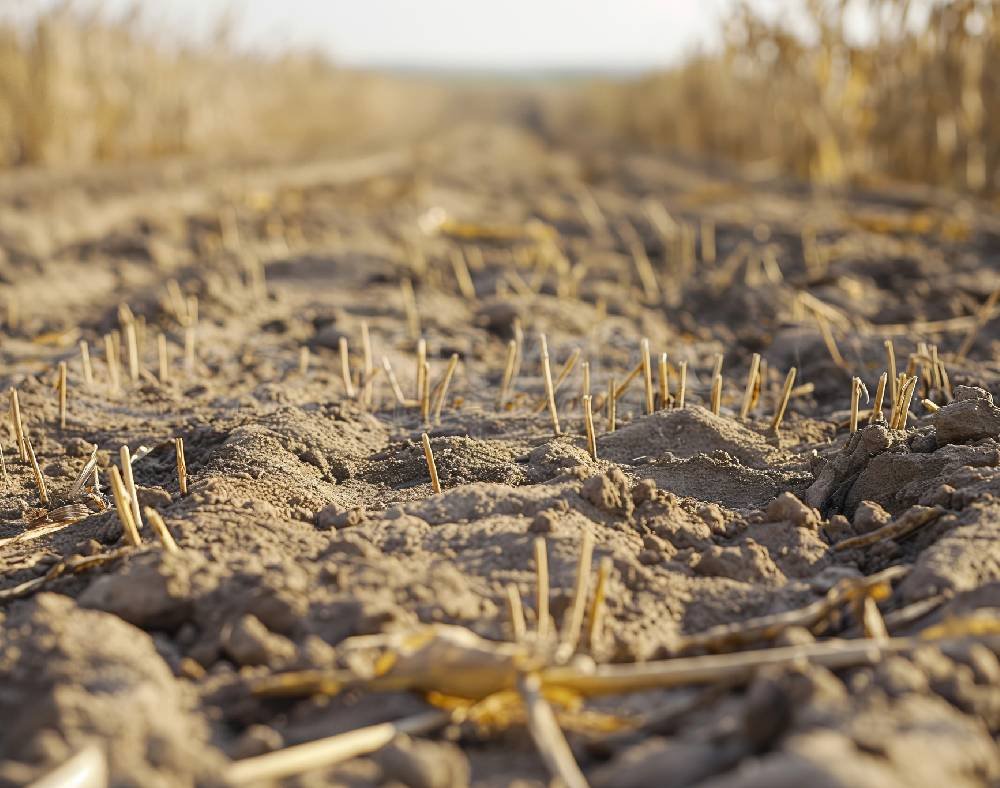
When harvest season arrives, the focus naturally shifts toward collecting the crop and preparing the field for the next season. But from the soil’s perspective, the process does not end when the crop is removed. In fact, the foundations of the next growing season continue to take shape during this period.
Throughout the growing season, plants take up water and nutrients from the soil. With harvest, some of these nutrients leave the field together with the crop. At the same time, stems, leaves, roots and other plant residues remain in the field. How these materials are managed can influence soil organic matter, structure, water retention and biological activity.
That is why the post-harvest period is an important opportunity to prepare the soil for the next growing season.
During the growing season, plants take up the nutrients they need for development. Part of the nitrogen, phosphorus, potassium and other elements in the soil becomes incorporated into plant tissues and leaves the field with the harvested crop.
However, not the entire plant is harvested. Roots, stems, leaves and other plant residues can provide an important source of organic material that can return to the soil.
The Food and Agriculture Organization of the United Nations (FAO) identifies plant residues and roots as important sources of soil organic matter. As these materials decompose, they provide energy for soil organisms and contribute to the recycling of some nutrients within the soil system.
For this reason, plant residues left in the field after harvest should not simply be viewed as material that needs to be removed. When properly managed, they can become part of the soil’s natural cycle.
Plant residues left on the field after harvest can form a protective layer over the soil surface. This layer can reduce the direct impact of raindrops and help limit the movement of soil particles, providing protection against erosion.
Plant residues can also help reduce water loss from the soil surface. Over time, they break down and become part of the organic matter cycle, while providing a source of energy for soil organisms.
According to the FAO, plant residues can help protect the soil surface from erosion, support water infiltration and retention, and provide nutrients for soil biological activity.
The United States Department of Agriculture’s Natural Resources Conservation Service (USDA-NRCS) also considers maintaining soil cover and retaining plant residues important practices for improving soil health.
Of course, the same approach does not apply to every field. Crop type, soil characteristics, climate, disease and pest risks, and the next crop all need to be considered. The key is not simply to leave residues in the field, but to manage them in a way that fits the specific production system.
Soil organic matter is one of the key components of healthy and productive soil. It is closely connected to the physical, chemical and biological properties of the soil.
Organic matter contributes to maintaining soil structure, retaining water, storing nutrients and supporting microbial activity.
This becomes particularly important in soils with low organic matter levels. Over time, declining organic matter can negatively affect soil structure and its ability to retain water.
Plant residues left in the field after harvest are one of the natural sources that help keep this cycle going. However, leaving residues in the field alone is not enough to solve soil organic matter problems. Soil tillage, fertilization, crop rotation and irrigation practices all need to be considered together.
Removing all plant residues from a field may seem practical in the short term. However, it can have consequences for soil in the long term.
A comprehensive meta-analysis published in 2024 examined 609 comparisons from 323 field experiments. The study found that removing crop residues after harvest was associated with an average 11% reduction in soil organic carbon stocks in the topsoil.
This finding highlights the role that crop residues can play in maintaining soil organic carbon. However, the effect is not expected to be the same in every region or production system. Climate, soil characteristics, crop type and the duration of the practice can all influence the outcome.
Another global meta-analysis found that residue retention combined with reduced tillage practices can contribute to increasing soil organic carbon stocks.
The main takeaway is clear: post-harvest residue management is not simply a matter of keeping a field clean. It is also a decision that can influence the long-term condition of the soil.
Between harvest and the next planting period, prolonged exposure of bare soil can increase the effects of rainfall and wind. This can become particularly important in sloping fields and areas that are vulnerable to erosion.
For this reason, keeping the soil covered with plant residues or using cover crops can be considered where conditions are suitable.
Cover crops are grown primarily to support the production system and protect the soil rather than to be harvested as the main commercial crop. According to USDA-NRCS, cover crops can help reduce erosion, support water infiltration, contribute to organic matter formation and improve nutrient cycling.
However, cover crops should also be selected carefully. Local climate, rainfall, soil characteristics, available water and the requirements of the following crop should all be taken into account.
One of the important characteristics of cover crops is that they keep living roots in the soil. Living roots continuously interact with soil microorganisms and provide a source of carbon to the soil system.
A global meta-analysis published in 2023 examined 93 peer-reviewed studies to evaluate the effects of cover crops on different soil organic carbon fractions. The study reported an average 12% increase in total soil organic carbon under cover cropping, while microbial biomass carbon increased by an average of 33%.
These findings show that cover crops can be an important tool for supporting soil health. However, their effects can vary depending on soil type, climate, plant species and the length of time they are used.
One of the most important steps during the post-harvest period is evaluating the current nutrient status of the soil.
The goal should not simply be to apply fertilizer, but to determine what the soil actually needs.
No two fields have exactly the same nutrient status. Even two fields growing the same crop can differ in pH, organic matter, nitrogen, phosphorus, potassium and other nutrient levels. Previous fertilization practices and crops grown in previous seasons can also affect the current condition of the soil.
For this reason, fertilizer planning for the new season should be based on soil analysis, crop requirements and local conditions.
The post-harvest period can therefore be a suitable time to evaluate the soil and develop a nutrient management plan for the next growing season.
Why does residue burning affect the future of the soil?
One of the important issues in post-harvest soil management is the burning of crop residues.
Burning residues removes a significant portion of the organic material that could otherwise remain within the soil system. It can also negatively affect soil organisms and organic matter.
The Turkish Ministry of Agriculture and Forestry emphasizes the importance of properly managing plant residues in its Good Agricultural Practices Code. The document also highlights the potential negative effects of residue burning on soil structure, moisture, nutrients and soil biological populations.
Post-harvest management should therefore not be limited to making the field look clean and empty. The potential contribution of plant residues to the soil and the wider production system should also be considered.
What can be done for the soil after harvest?
Post-harvest practices should be adapted to each field and production system. However, several basic principles can help guide the process.
Evaluate the soil through analysis.
Determining soil pH, organic matter and nutrient levels can help support more accurate fertilizer decisions for the next season.
Manage plant residues thoughtfully.
Depending on disease and pest risks, crop rotation and local conditions, residues can be retained, incorporated or managed in another appropriate way.
Avoid leaving the soil bare unnecessarily.
Where conditions allow, plant residues or cover crops can help protect the soil surface.
Plan tillage according to actual needs.
Excessive and intensive tillage can disturb soil structure and accelerate the breakdown of organic matter. Tillage methods should therefore be selected according to soil characteristics, crop requirements and the overall production system.
Think about the next season early.
Post-harvest decisions can influence not only the current condition of the field but also the starting conditions for the next crop. Soil management should therefore be viewed as a continuous process between growing seasons.
Harvest is not the end of the soil cycle
Once the crop has been removed from the field, the production season may appear to be over. But life in the soil continues.
Plant residues decompose, microorganisms remain active, organic materials continue to transform and nutrients move between different forms. Soil structure and water balance also continue to change during this period.
Sustainable agriculture is therefore not only about producing more. It is also about protecting the soil in which that production takes place.
Understanding the needs of the soil after harvest, managing plant residues properly, maintaining organic matter and preparing an appropriate nutrient management plan are all important steps toward long-term productivity.
Because the preparation for the next growing season does not begin only when planting starts. It begins immediately after harvest.
Food and Agriculture Organization of the United Nations (FAO). The Importance of Soil Organic Matter.
Food and Agriculture Organization of the United Nations (FAO). Conservation Agriculture.
USDA Natural Resources Conservation Service (NRCS). Soil Health Management.
USDA Natural Resources Conservation Service (NRCS). The Role of Organic Matter.
USDA Natural Resources Conservation Service (NRCS). Cover Crops for Soil Health.
Li, Y., et al. (2020). Residue retention promotes soil carbon accumulation in minimum tillage systems: Implications for conservation agriculture. Science of the Total Environment, 740, 140147.
Bolinder, M. A., et al. (2020). The effect of crop residues, cover crops, manures and nitrogen fertilization on soil organic carbon changes in agroecosystems: A synthesis of reviews. Mitigation and Adaptation Strategies for Global Change.
Lu, X. (2020). A meta-analysis of the effects of crop residue return on crop yields and water use efficiency. PLOS ONE, 15(4), e0231740.
Soil organic carbon fractions in response to soil, environmental and agronomic factors under cover cropping systems: A global meta-analysis. (2023). Agriculture, Ecosystems & Environment, 355, 108591.
A quantitative review of the effects of residue removing on soil organic carbon in croplands. (2024). Soil & Tillage Research.
Republic of Türkiye Ministry of Agriculture and Forestry. Good Agricultural Practices Code – Crop Residue Management.
Citsa Tarım © 2026
copyright