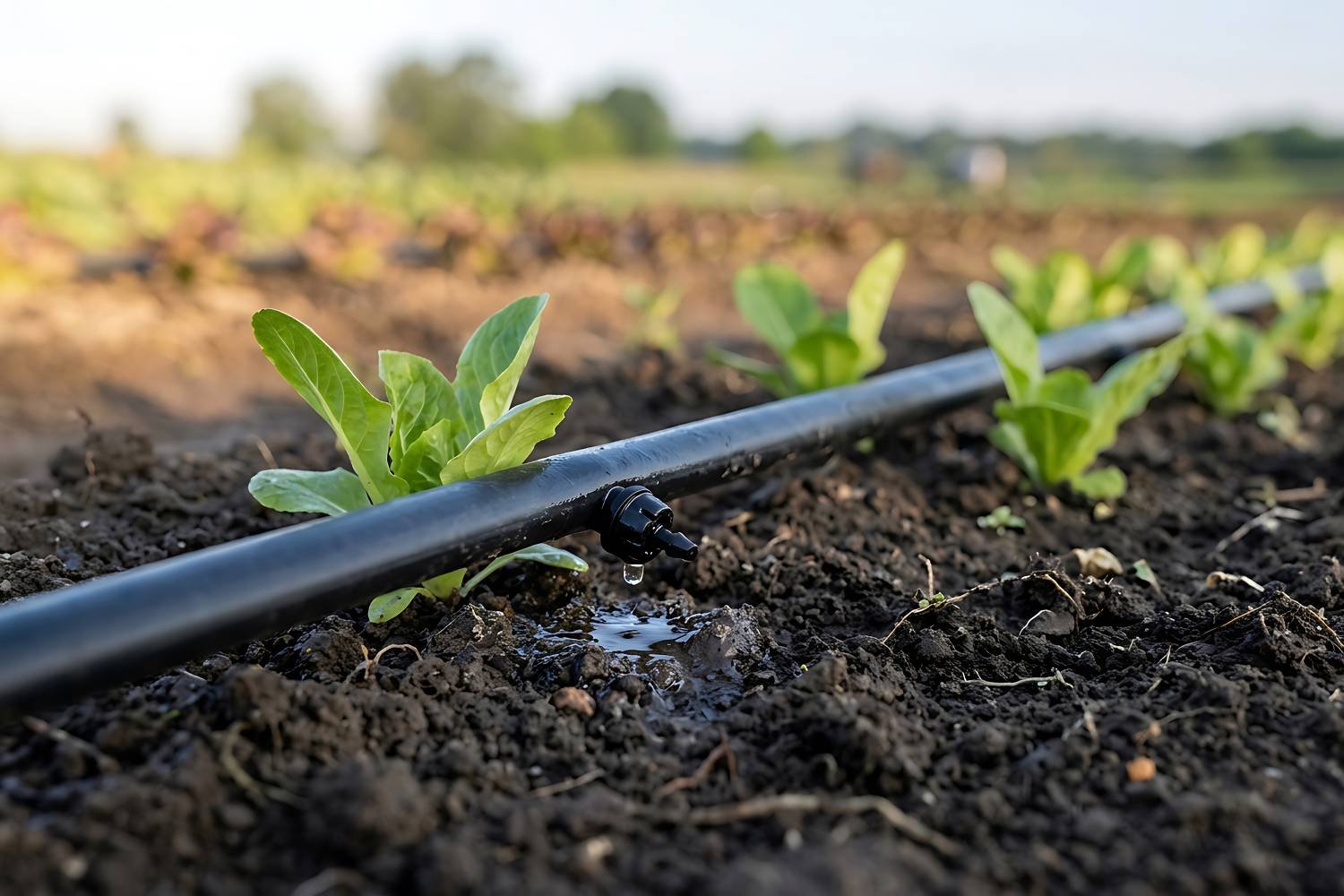
You applied fertilizer through the irrigation water, and a few weeks later the emitters clogged. Or you fertilized, and the crop still didn’t develop as well as it should have. One possible cause in both cases is a fertigation program planned around fertilizer quantity alone. A successful application depends on water analysis, how the system operates, fertilizer compatibility and timing, all considered together.
What is fertigation?
Fertigation means delivering fertilizer to the root zone together with the irrigation water. Water-soluble fertilizers suited to the irrigation system are fed into the line with an injection unit and pass through the emitters into the soil.
According to Hakgören’s 1993 review, root development is dense in the limited area wetted by drip emitters. Applying fertilizer to this zone therefore keeps nutrients where the roots are most concentrated. This allows more controlled nutrient management in the plant’s active root zone.
Fertigation, however, is not simply putting fertilizer in a tank and starting the irrigation. The system must work properly, and nutrients must reach the crop in the amounts it needs.
What does the research show?
The 2023 meta-analysis by Delbaz and colleagues, published in Agricultural Water Management, brings together 32 studies on the effects of fertigation on agricultural production.
In the studies they reviewed, the researchers reported that surface and drip fertigation raised average yield by 20%, nutrient use efficiency by 26% and water productivity by 51%. The analysis also associated applying 75% of the recommended fertilizer dose with favorable yield results.
These results should not be read as a fertilizer recipe valid for every crop and field. The analysis combines studies conducted under different conditions and covers annual crops. Cutting the fertilizer dose by 25% will therefore not give the same result in every production system. The right amount should be determined from soil and water analyses, the crop’s needs and the production conditions.
Another study on tomatoes shows the importance of the fertigation equipment. In a trial run in 2014-2015, Baydar and Ünlü compared injection pump, venturi and pressure-differential methods at different irrigation levels. In the first trial year, full irrigation gave the highest yield with every method. The highest yield, 4,875 kg per decare (da), was measured with the injection pump under full irrigation. Yields ranged from 3,660 to 4,875 kg/da with the injection pump, 3,760 to 4,514 kg/da with the pressure-differential method and 2,803 to 3,721 kg/da with the venturi. The authors note that the venturi and pressure-differential methods could not deliver fertilizer to the root zone at the desired concentration and amount.
This result suggests that production outcomes may be linked not only to the fertilizer used but also to how it is fed into the system and to the irrigation level. That said, this was a tomato trial run under specific conditions, and it does not mean the same results will be obtained in every irrigation system.
Step-by-step fertigation
Soil pH, electrical conductivity (EC) and available nutrients should be assessed. For irrigation water, it is important to know values such as EC, pH, bicarbonate, calcium, magnesium and sulfate.
These analyses help evaluate both the crop’s nutrient requirement and any problems that may arise from interactions between the irrigation water and fertilizers.
Applying a nutrient that is already sufficient in the soil adds unnecessary cost and can upset nutrient balance. Likewise, choosing fertilizers without considering the water’s chemistry increases the risk of precipitates forming and emitters clogging.
Before applying fertilizer, check filters, pipes, pressure readings, emitter flow rates and the injection equipment.
If emitters deliver different amounts of water, fertilizer will not be distributed evenly among plants either. It is therefore not enough for the system simply to be running; water distribution should be as uniform as possible.
The position of the injection point, the filter arrangement and the backflow-prevention equipment must suit the system’s design. Whether filters sit before or after the injection point should be decided according to the system’s layout and the manufacturer’s instructions. Suitable protective devices must also be in place to prevent fertilizer from flowing back to the water source.
A crop’s nutrient needs change over the season. The amount and balance of nutrients required can differ across vegetative growth, flowering, fruit set and fruit enlargement.
Rather than applying the same fertilizer mix and amount all season, prepare a program based on crop development and analysis results. Splitting the seasonal fertilizer requirement into suitable intervals may make nutrient management easier.
The 2024 review by Chtouki and colleagues discusses how fertilizer form, soil properties and application frequency matter in applying phosphorus through drip fertigation. Problems such as phosphorus fixation in the soil and precipitate formation should be taken into account when preparing the program.
One of the major problems in drip systems is fertilizers reacting with the irrigation water or with each other to form insoluble compounds.
Mixing calcium nitrate with phosphate fertilizers in the same concentrated stock tank can cause precipitates to form. Mixing calcium-containing products with sulfate fertilizers as concentrated solutions carries a similar risk. The UC ANR guide gives the example of mixing calcium nitrate with potassium sulfate: both are water soluble, but when mixed together they form gypsum, which is far less soluble.
For this reason, calcium fertilizers should not be mixed with phosphate or sulfate fertilizers in the same concentrated stock tank. Separate tanks or separate applications can be used, but the order and suitability of applications should be determined according to the water’s properties, the fertilizer formulations and the product instructions.
To assess the risk of precipitation from fertilizer mixing, the University of California Agriculture and Natural Resources division (UC ANR) recommends analyzing the irrigation water for calcium, magnesium, bicarbonate and sulfate. According to the guide, if any of these exceeds 2.5 meq/L, the water may form precipitates with certain fertilizers. The guide also recommends a jar test.
In a jar test, the fertilizer is mixed with water at the concentration that will occur during fertigation, left covered overnight and then observed. If the mixture turns cloudy or white, or a precipitate settles at the bottom, precipitation in the drip lines is likely. The test should be repeated often, especially with phosphate fertilizers, because fertilizer properties can vary by manufacturer. However, the absence of visible precipitate does not guarantee that a mixture is safe under all conditions. Because some mixtures can generate heat, follow product safety instructions during the test and consult the manufacturer for any doubtful mixture. Because so many of these chemical reactions are unpredictable, the UC ANR guide states that the best policy is not to mix fertilizers at all where possible.
A fertigation event generally runs in three stages:
Injection time and flushing time should be set according to system flow rate, line length, emitter positions and the time the fertilizer takes to travel through the system. The aim is for the fertilizer to distribute properly along the line and leave no unwanted residue in the system.
Inadequate flushing can increase the risk of fertilizer residue and precipitate forming in the lines. On the other hand, excessive irrigation can carry mobile nutrients such as nitrate below the root zone. This risk depends on soil structure, drainage conditions, the amount of irrigation and the mobility of the nutrient.
Emitter clogging: causes and prevention
Emitter clogging does not come from fertilizer mixes alone. Naturally occurring minerals in irrigation water, iron and manganese compounds, biological growth and filtration problems can also cause clogging.
The UC ANR technical guide on microirrigation systems describes the main situations that can lead to chemical precipitation:
Calcium carbonate (lime): When the bicarbonate concentration in irrigation water rises above about 2 meq/L and the pH exceeds 7.5, the risk of calcium carbonate precipitation increases. Using calcium-containing fertilizers with water that has these properties can raise the risk. Higher temperatures can also reduce the solubility of calcium carbonate and make precipitation easier.
Calcium phosphate: Phosphate fertilizers can react with the calcium and magnesium in irrigation water. The UC ANR guide states that calcium or magnesium concentrations above roughly 2.5 meq/L can pose a precipitation risk with some phosphate fertilizers. These values are not exact limits valid under all water conditions. They are approximate indicators that can be used in risk assessment.
Calcium sulfate (gypsum): Using sulfate fertilizers with irrigation water high in calcium may cause gypsum to precipitate under suitable chemical conditions. This risk depends on the water’s calcium and sulfate content and on the application conditions.
To prevent these problems, the irrigation water should be analyzed, the chemical compatibility of fertilizers checked and the irrigation system’s maintenance program carried out regularly.
Using acid with phosphorus fertilizers
Reactions between phosphorus fertilizers and the calcium and magnesium in irrigation water can clog emitters. In some cases, acid can help manage the water’s chemical balance. Acid use, however, should not be planned on the basis of a general pH target alone.
UC ANR states that lowering the water’s pH to 5 or below may be needed to prevent some phosphate precipitates from forming, but that the amount of phosphoric acid required for this can exceed the crop’s fertilizer needs.
This does not mean that pH should be brought down to 5 in every irrigation water. The type and amount of acid should be determined under expert supervision, after evaluating the water analysis, alkalinity, the ions present, the fertilizer used and the system’s characteristics. Because acids can pose serious safety risks when used incorrectly, application must follow product instructions and appropriate occupational safety procedures.
The 2024 review by Chtouki and colleagues also examines the different forms of phosphorus fertilizers and drip fertigation practice in the Mediterranean region. The differences between orthophosphate and polyphosphate forms matter, but polyphosphate use should not be assumed to prevent clogging under all conditions.
Three common mistakes in the field
Applying without measuring injection volume. If you do not know how much fertilizer solution the injector draws, a program built on it may leave the target nutrient amount undelivered or overapplied.
Giving every plot the same recipe. Even within one farm, soil properties, water quality, crop development and yield targets can differ. The fertilizer program should be assessed according to these differences.
Not monitoring results after application. Crop development, soil moisture and, where needed, leaf analyses should be tracked. Updating the program during the season based on the results can prevent unnecessary applications.
Frequently asked questions
Can every fertilizer be applied through drip irrigation?
No. The fertilizer must dissolve properly in water, be compatible with the irrigation water and not form precipitates in the system. Check the usage instructions and fertigation suitability on the product label.
Does fertigation completely replace conventional fertilization?
Not under every condition. The choice of method depends on crop type, soil properties, the irrigation system and the farm’s production conditions. In some production systems, different fertilization methods can be used together.
Should I apply fertilizer at the beginning or the end of irrigation?
In general practice, system pressure is stabilized first, then the fertilizer is injected, and the lines are flushed with clean water at the end of the application. Injection and flushing times should be set according to the system’s characteristics.
Can calcium nitrate and phosphorus fertilizer be used in the same tank?
Mixing them in the same concentrated stock tank is not recommended because of the risk of precipitation. UC ANR’s compatibility list also shows calcium nitrate as incompatible with ammonium phosphates, ammonium sulfate, ammonium nitrate and potassium chloride. Separate tanks or separate applications can be used. The application plan should be prepared according to product compatibility and the irrigation water analysis.
If I reduce the fertilizer amount, will yield drop?
This depends on the crop’s current nutrition status and production conditions. In the meta-analysis by Delbaz and colleagues, 75% of the recommended dose allowed lower fertilizer use without a significant yield drop on average across the studies reviewed. This does not mean that every field should have its fertilizer dose cut by 25%. The dose should be set according to analysis and crop needs.
Conclusion
The success of fertigation depends not only on the fertilizer used but also on the analyses done before application, the condition of the irrigation system and a sound mixing plan. When water and fertilizer are managed together, it can be possible to meet the crop’s nutrient needs in a more controlled way. To achieve this, instead of applying the same program to every field, adopt an approach based on measurement, observation and scientific knowledge.
When soil and irrigation water analyses, the crop’s growth stage and the system’s characteristics are assessed together, a more accurate plant nutrition program can be built.
At CİTSA, we believe effective plant nutrition rests on accurate analysis, suitable product selection and informed application.
References
Citsa Tarım © 2026
copyright